Yes, a rush on eggs has caused panic throughout the Jerusalem streets.
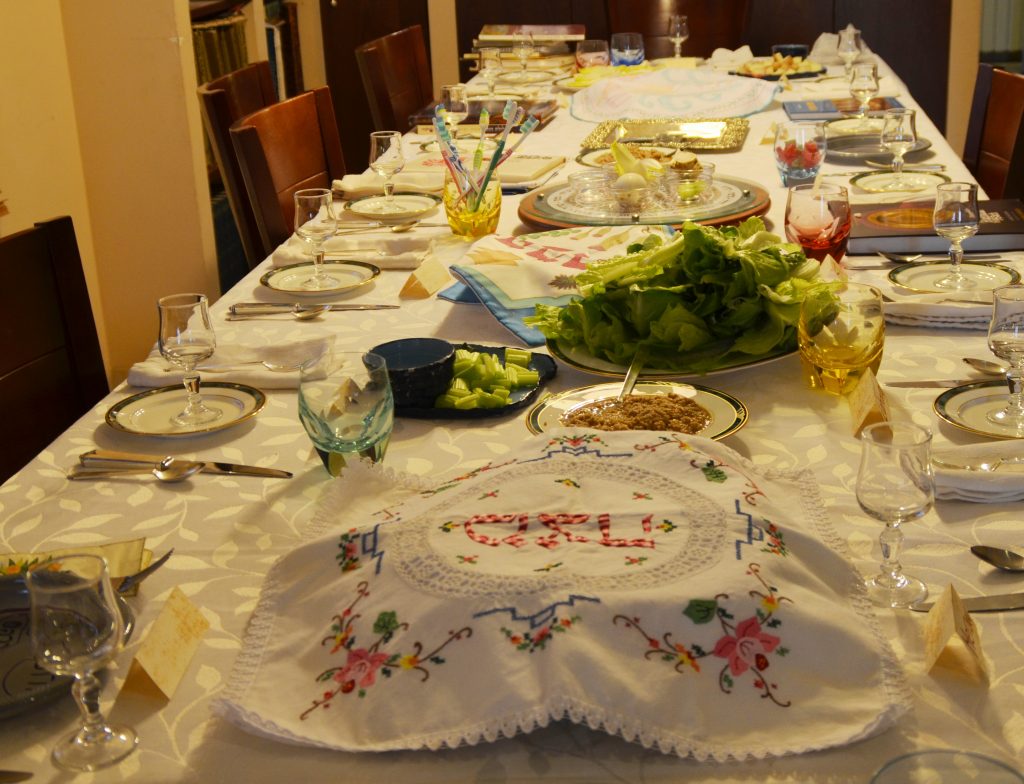
The rest of the world may have hoarded toilet paper but in Jerusalem, eggs were grabbed off the shelves and stashed away in large quantities. People might be in isolation for the Passover holiday, but they were not going to be caught short of eggs. Facebook friends were posting frantic messages.
I got the Sec-Gen’s phone number. In response to my message, he replied, “Tomorrow will be enough eggs in the supermarkets. People are in a little panic but I think that it’ll be stopped soon. Yours, Abu.”
So there you have it. But I still hear complaints about an egg shortage.
Eggs for Passover set off panic in the Jerusalem streets.
Meanwhile, Olim, new immigrants keep on arriving, knowing they will be sent into 14-day isolation because of COVID-19.
Having been off the streets this past week, I have been following Zoom sessions and webinars.
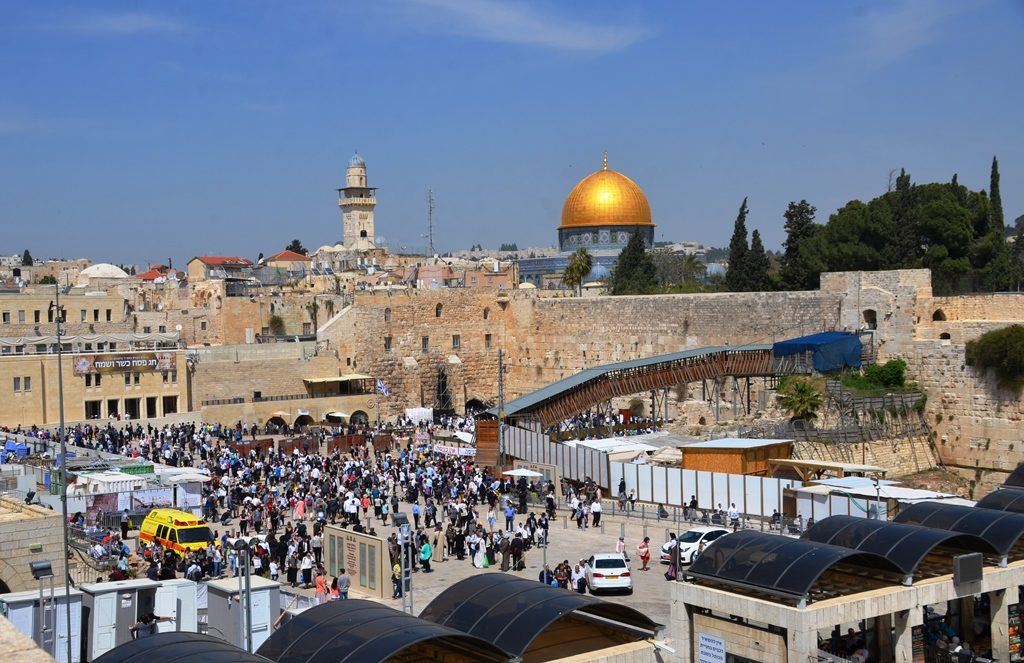
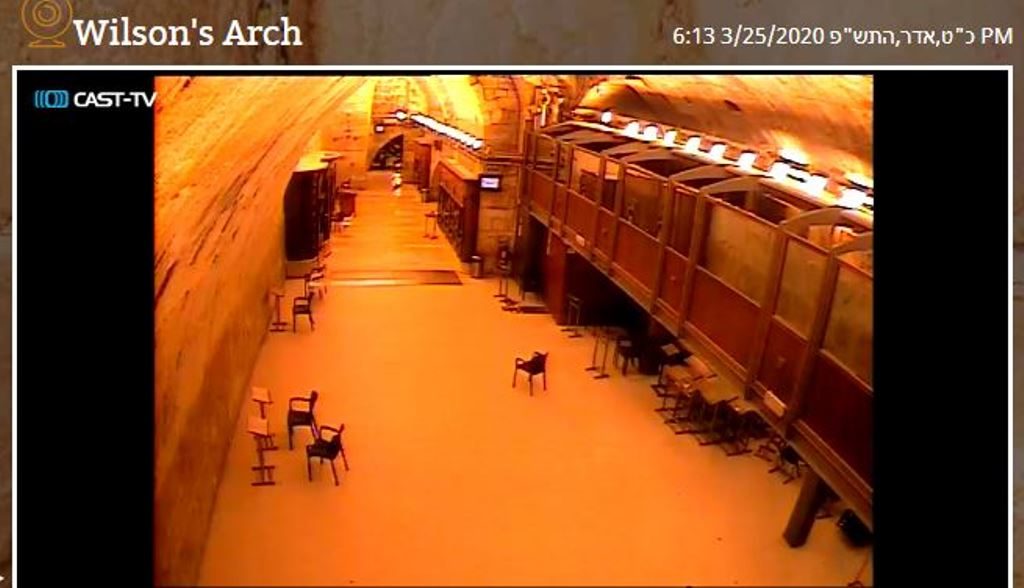
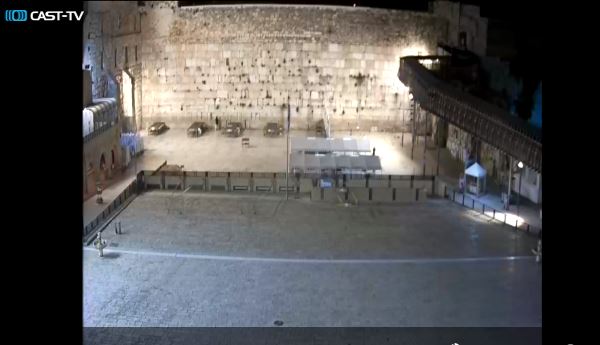
I have also been following scenes from the Western Wall Heritage Center WebCam much more often. This view is of the locked Wilson’s Arch on the evening of Rosh Chodesh Nissan. They have since straightened up the chairs. However, that lone empty chair caught my eye.
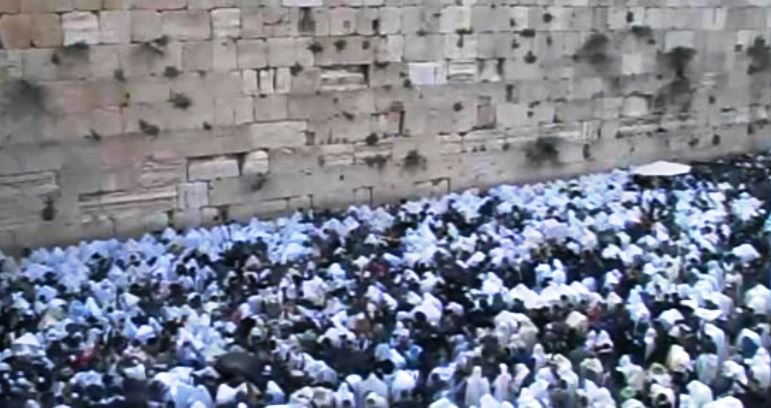
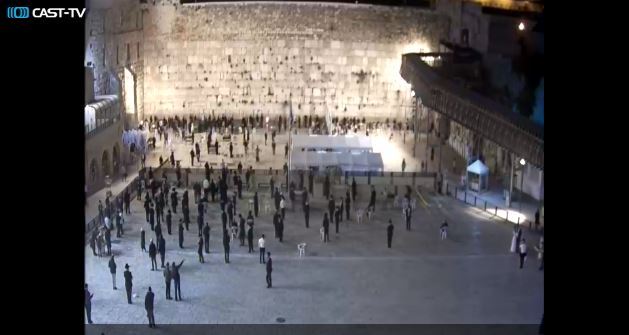
For a mass prayer of tehilim, psalms for healing, there was a distanced crowd last week.
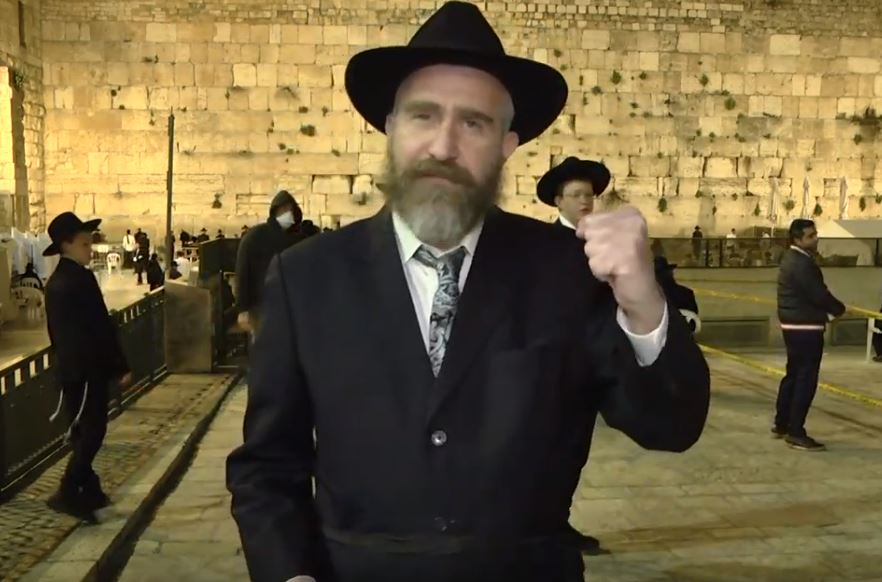
Facebook Live-streamed as the rabbi spoke and people watched around the world.
On another coronavirus night, one lone man was seen near the Kotel.
photo credit: The Western Wall Heritage Foundation
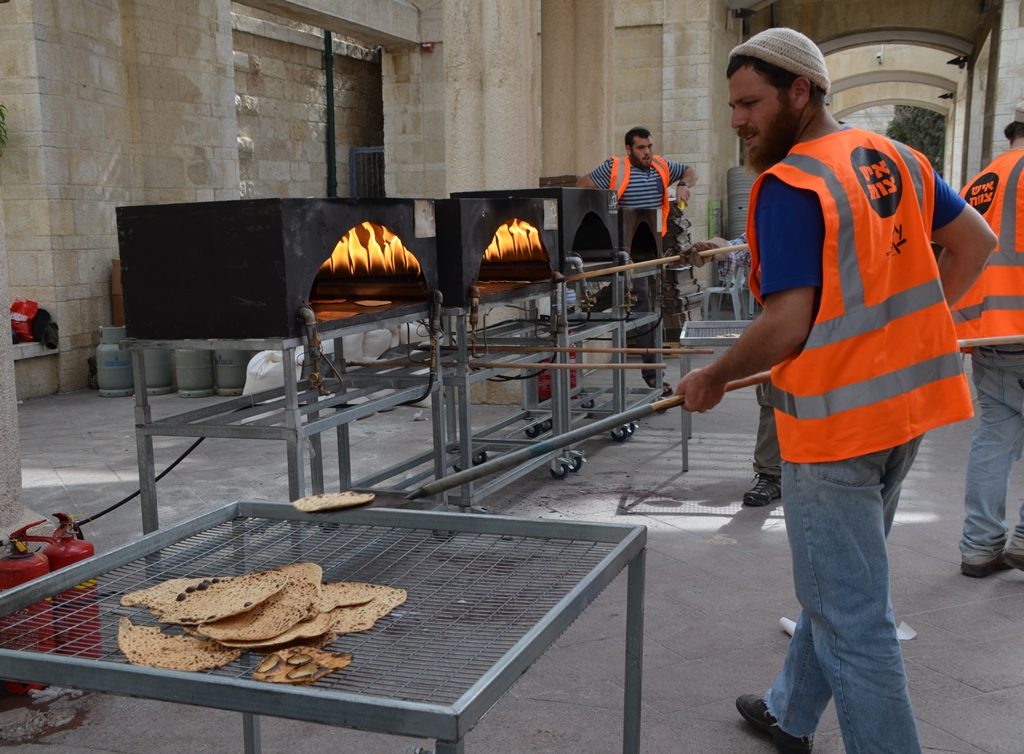
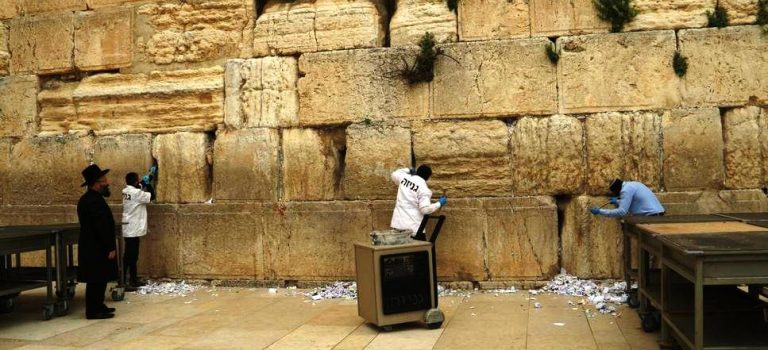
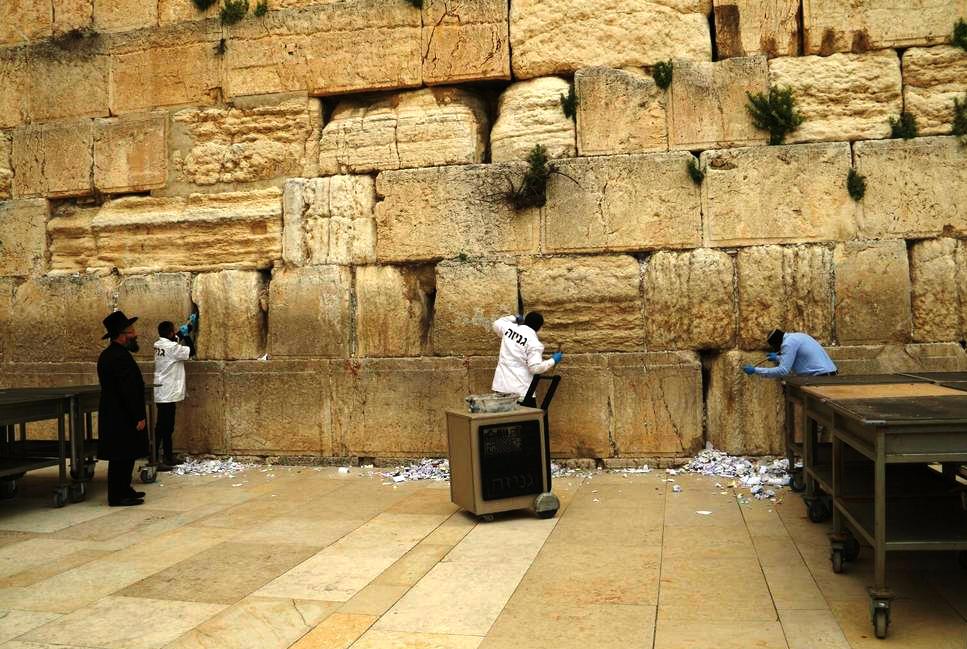
The notes were cleared out of the Kotel almost as usual before Passover.
There was a social distancing of workers and no holiday crowds this year.
More and more events have moved online for work and for conferences.
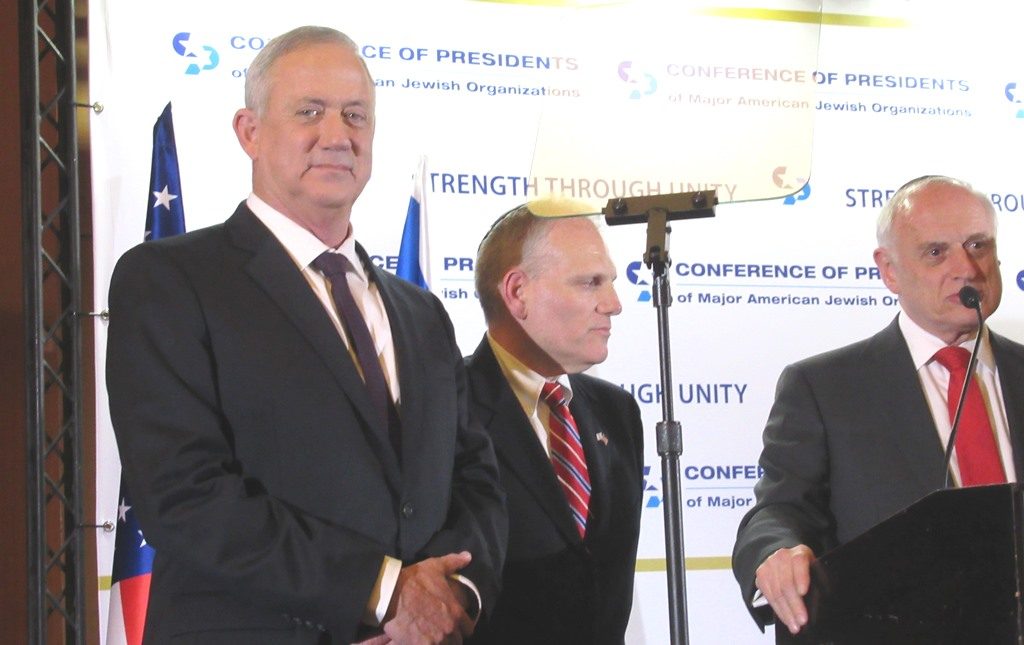
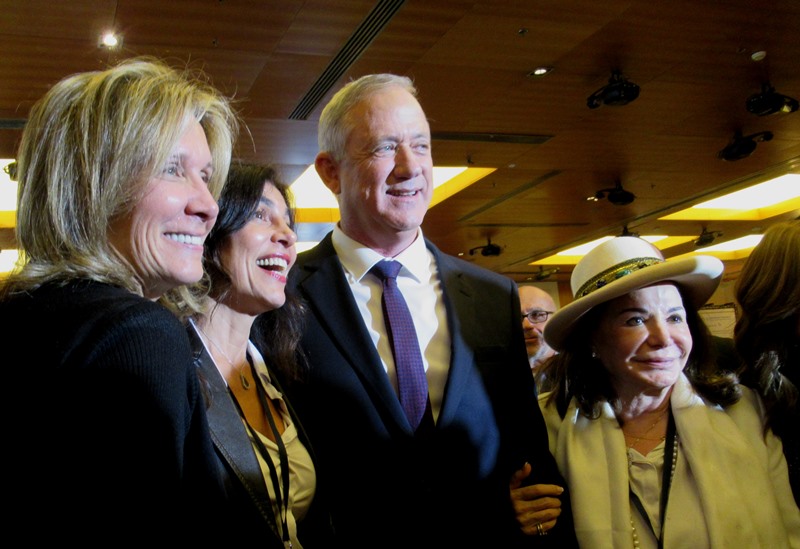
And willingly posed for photos before running off to an election event.
I was hoping to say that the unity government was in place.
Maybe next week?
Photo credit: Courtesy Beit HaNasi
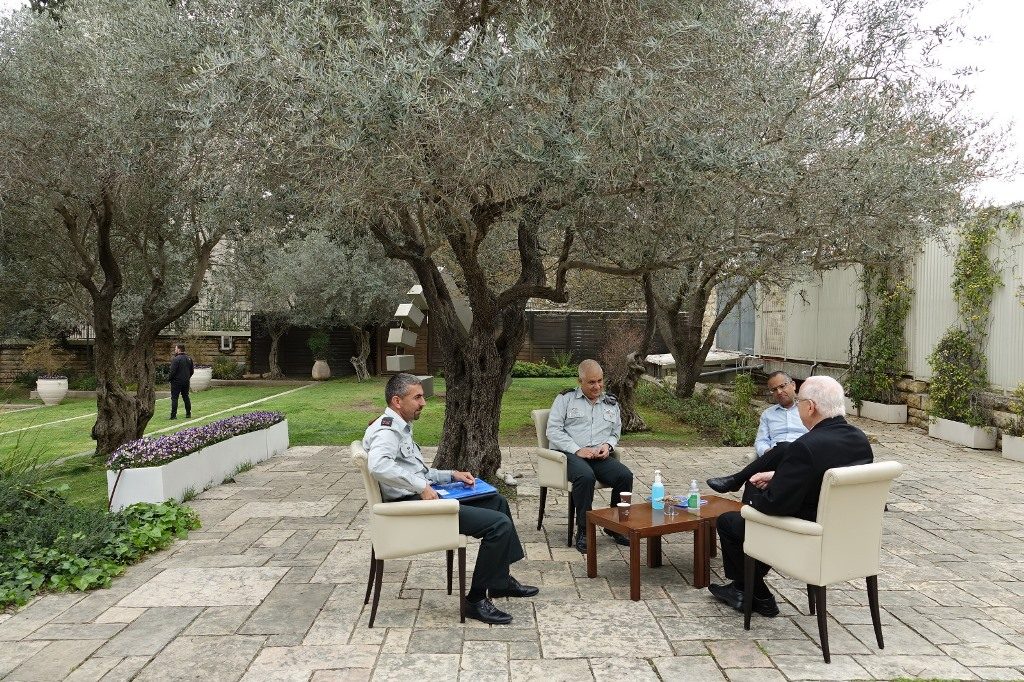
President Reuven Rivlin met with the Head of the IDF Manpower Directorate, for a briefing on IDF efforts to halt the spread of the virus in light of the global pandemic. In light of the instructions, the meeting was held in the garden of Beit Hanasi, at the appropriate distance.
This current coronavirus operation has been named “Ray of Light” by the IDF.
No on-site visitors are allowed, but Beit Hanasi has posted its first virtual tour. I have shared many photos from these spots, but this video includes background information.
As Dr. Tzvi Sheleg said discussing the COVID-19 situation at the Galilee Medical Center, “Emergency preparedness is part of our DNA.”
The Defense Minister announced that hundreds of IDF teachers are helping the doctor’s children all over Israel as part of a project called “Educational Framework.”
Magen David Adom (MDA) has begun collecting plasma units from those patients who recovered from Corona. Based on the assumption that those who have recovered from the disease have developed special anti-virus proteins (antibodies) in their plasma, these units could provide patients with a “passive vaccine” that may help them cope with the disease.
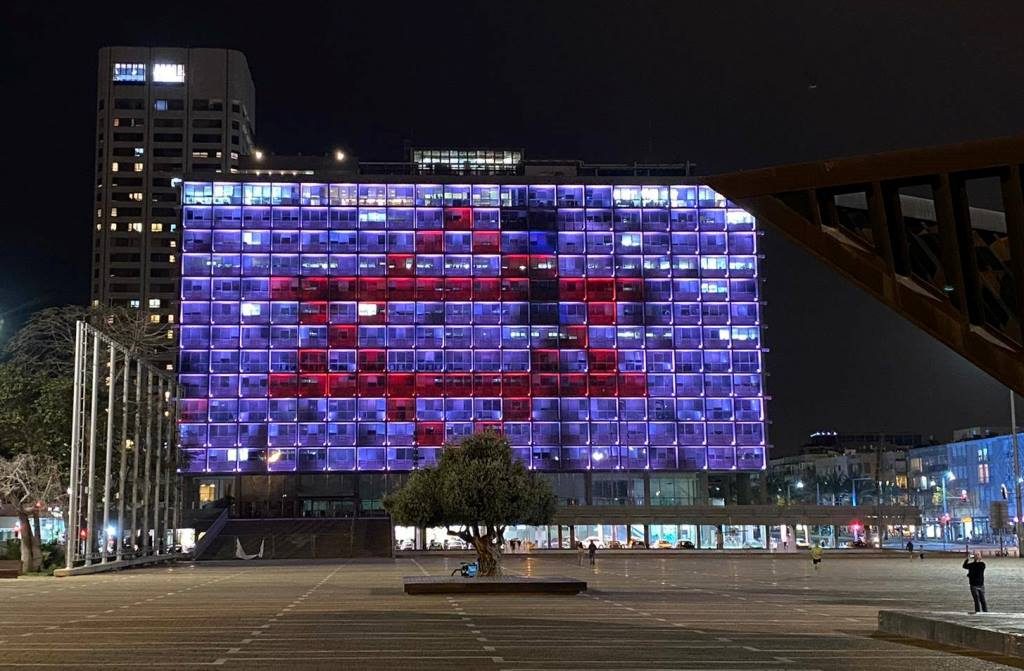
Photo credit: Tel Aviv Jaffa municipality
The Tel Aviv municipal building was lit with the MDA symbol to show appreciation for the thousands of health care workers on the front lines in what has been described repeatedly as a war against the tiny microbe. Approximately 8,000 people were sampled yesterday by MDA teams, of whom 4,000 were in the “Drive-Thru” complexes across the country.
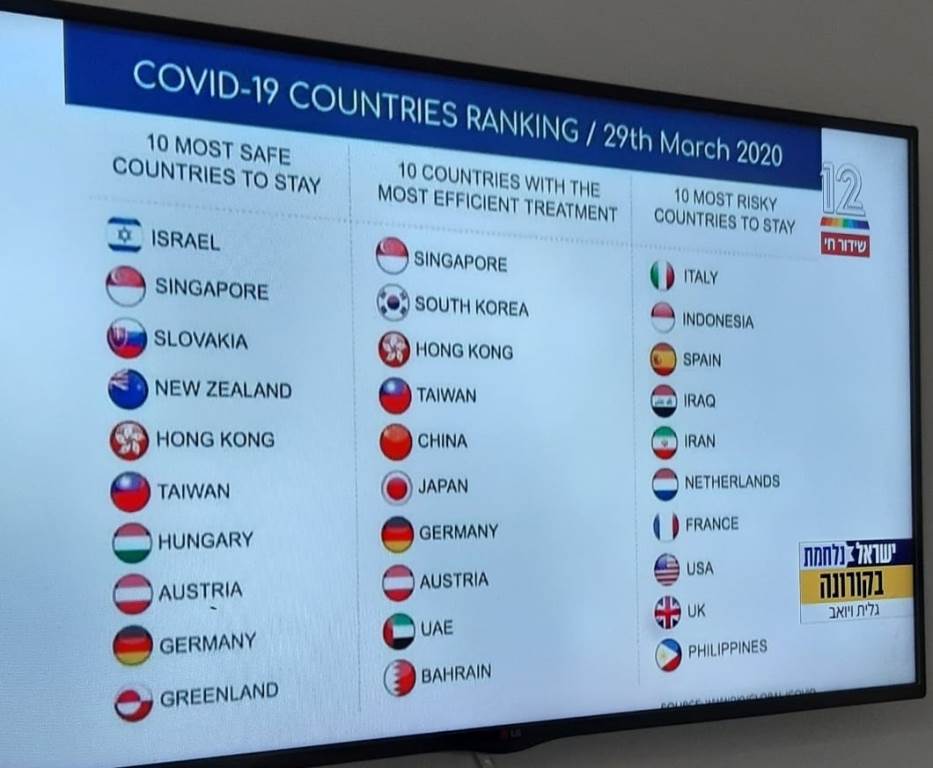
On the very good news front, the Deep Knowledge Group, a consortium of commercial and non-profit organizations active in the realm of DeepTech from scientific research, has ranked Israel above Singapore as the safest country to stay. Ok, for efficient treatment it is not rated so high.
But Singapore is a very different culture. There are cameras everywhere. Do NOT try spitting gum out on the street! People follow orders. They have smaller family units. In Israel, even with the President sitting away and outside with only one staff member, protests are still allowed. Dozens of people have assembled in Tel Aviv on the beach to drive to Jerusalem to protest at the Knesset.
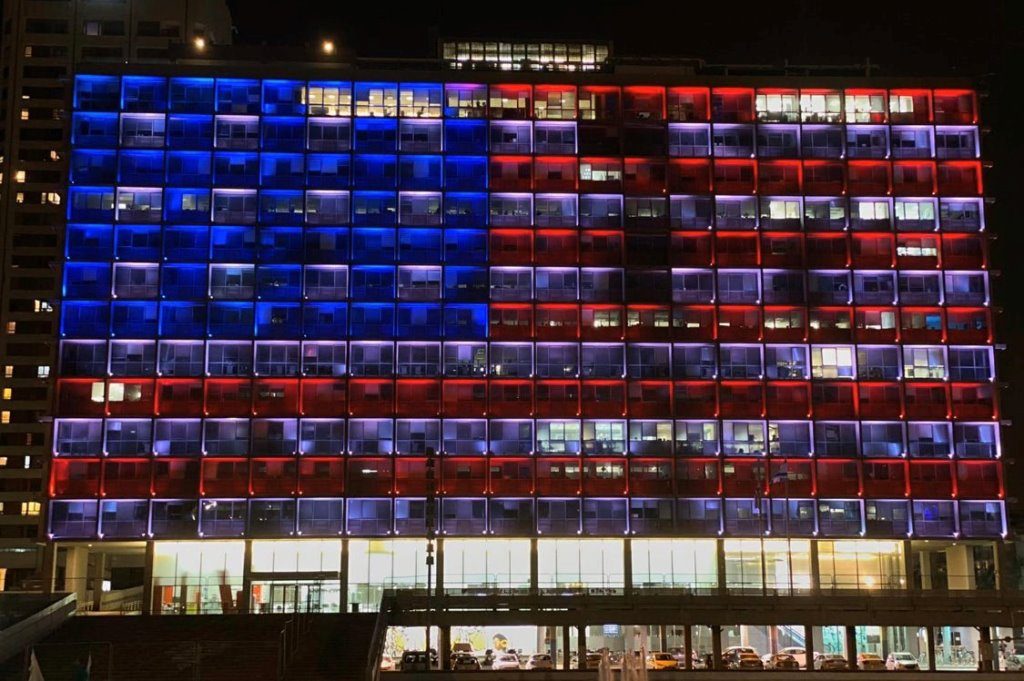
Photo credit: Tel Aviv Jaffa Municipality
Last night Tel Aviv municipal building was lit with the “US flag in solidarity with the American people and the residents of our partner cities…We hold you close to our hearts,” tweeted the Mayor of Tel Aviv.
Also, it was done as a sign of gratitude to supporters and friends of Tel Aviv around the US who have shown their support by making significant contributions to the individuals and communities most affected by the coronavirus in Tel Aviv.
Where ever you are, stay safe and healthy.
Hope to see you back soon for more from the Jerusalem streets.
In Jerusalem, Israel, and throughout the world, ‘Pandemic’ was used a lot this past week.
COVID-19 has spread fear from Wuhan around the globe.
After initial missteps, healthcare systems are learning to meet the challenge.
In Israel, increasing restrictions on movement to slow down the spread of the contagious virus have been announced. Dr. Asher Salmon (Shalmon) Israeli Ministry of Health – Head of International Relations has stated Israel has been watching the novel coronavirus since the middle of December.
Last week I joined a mHealth Israel Webinar with medical and technology experts from the US, Germany, Singapore, and Israel to hear what has been learned and recommended best practices.
Most of us are suffering from an ‘Infodemic’ according to Dr. John Whyte, Chief Medical Officer, WebMD. We are being bombarded by information. There was a 6700% increase in internet searches of sore throat and fever. In a Google search, however, he stressed to the international participants, information can be misleading, top-ranked sources are not as important as trusted sources for information.
In Jerusalem, a couple of quick examples of misinformation were from viral Facebook posts. One was supposedly a wedding in a supermarket. It was really a wedding photoshoot and the wedding was held elsewhere.
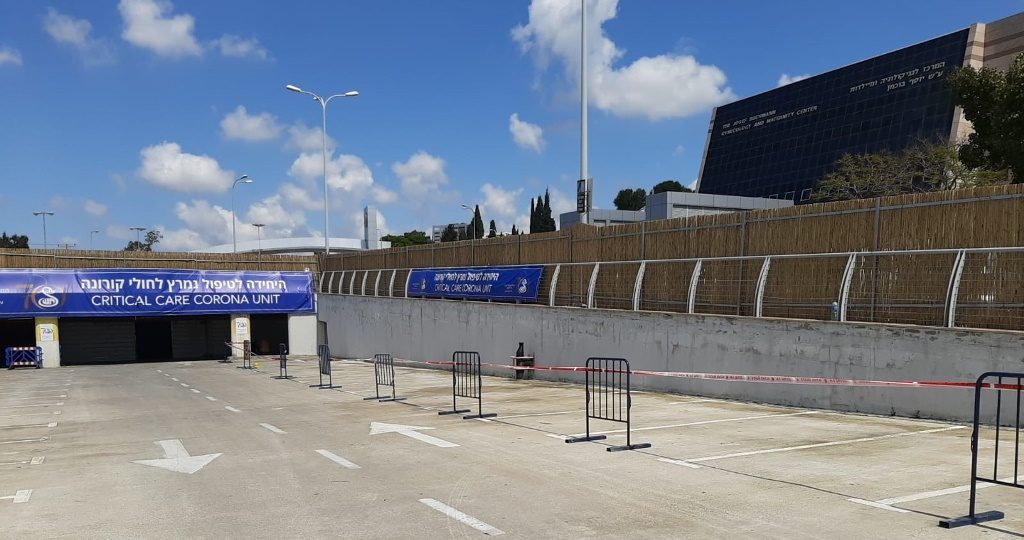
Much more serious was a series of photographs, supposedly of Jerusalem’s Mamilla Mall parking lot being prepared as an emergency COVID-19 hospital. If you looked carefully at the multiple images, it was obviously NOT Mamilla, and NOT in Jerusalem.
It was the underground parking in Tel HaShomer – Sheba Hospital, which has now been transformed into a 40 bed Corona Critical Care Unit – CCCU.
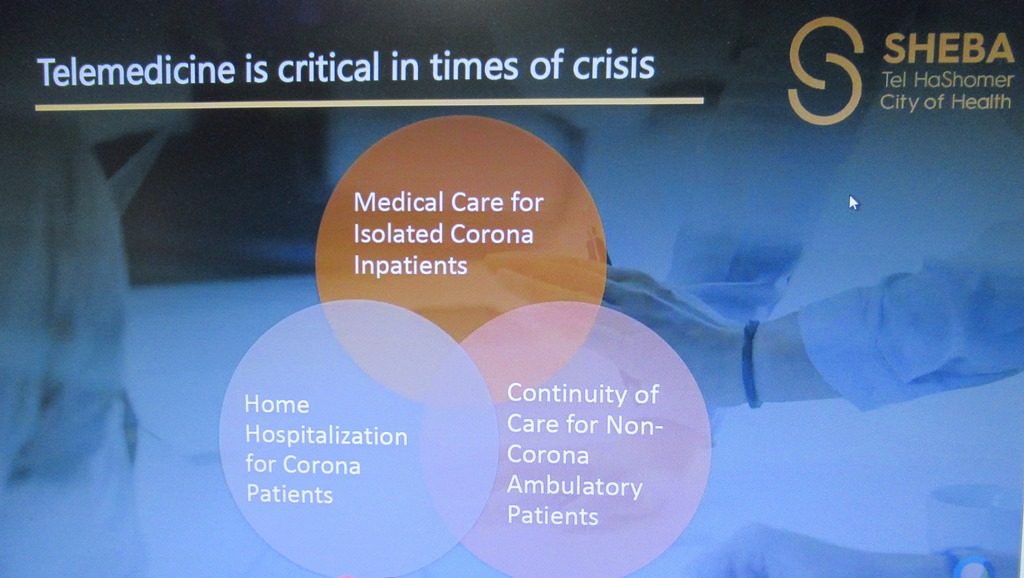
Dr. Galia Barkai, Head of Telemedicine, Sheba Medical Center presented what was being done to meet the challenge of COVID-19. Much of her presentation seemed like science fiction. I have gone to dozens of evenings where Israeli startups have presented. It was wonderful to see some Israeli tech advances being put to use.
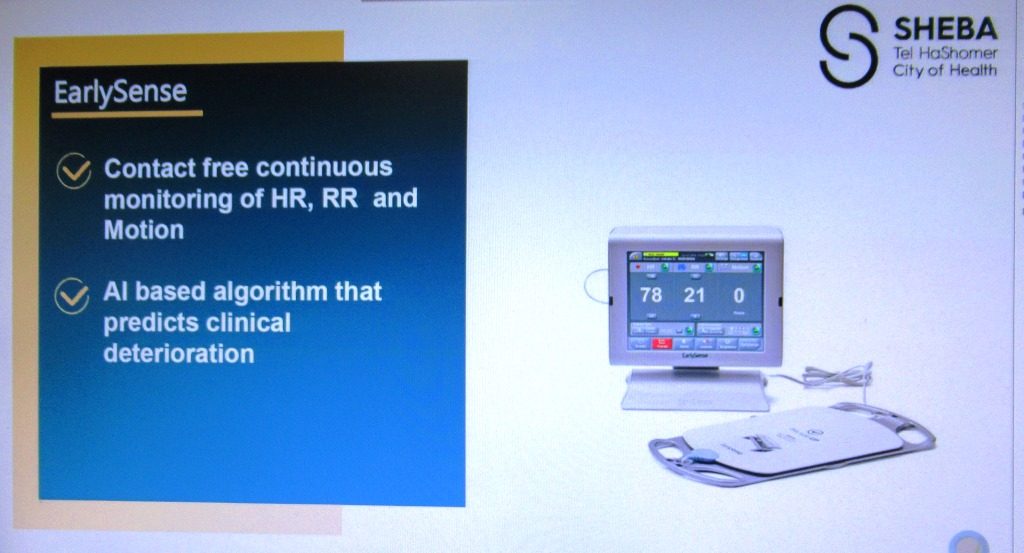
For example, EarlySense, where medical professionals can monitor a patient’s condition without physical contact.
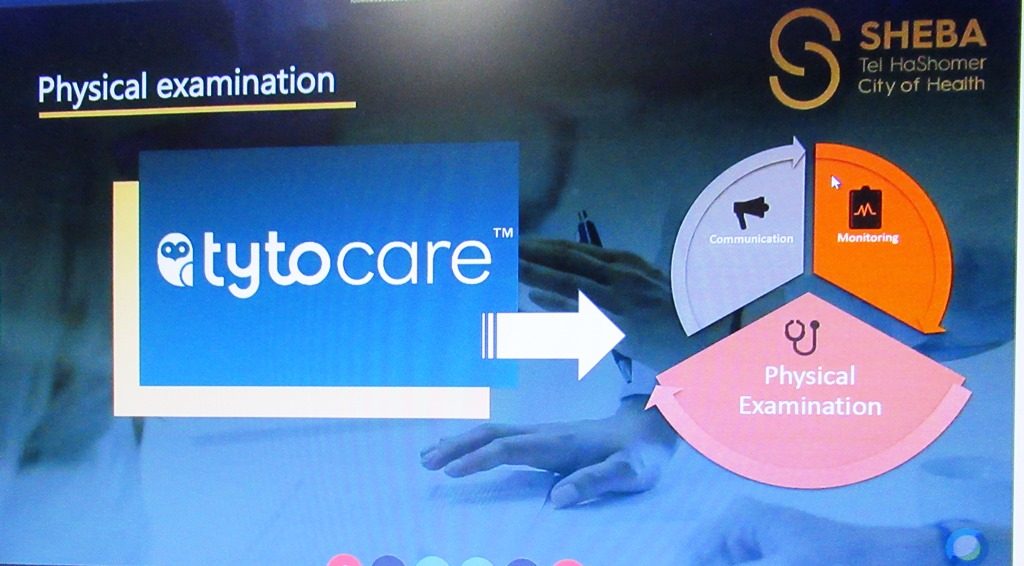
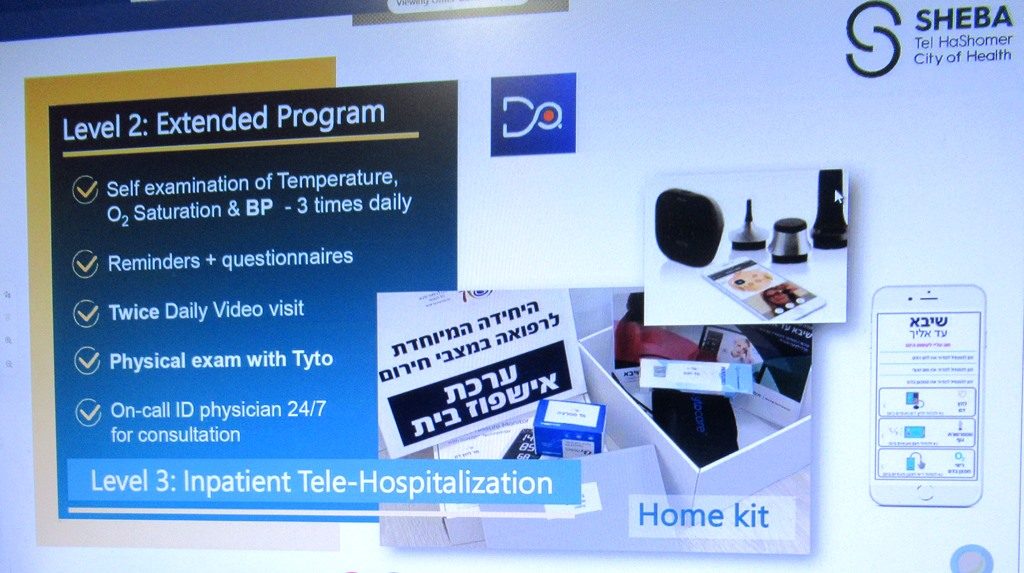
And Tytocare, a physical examination without contact.
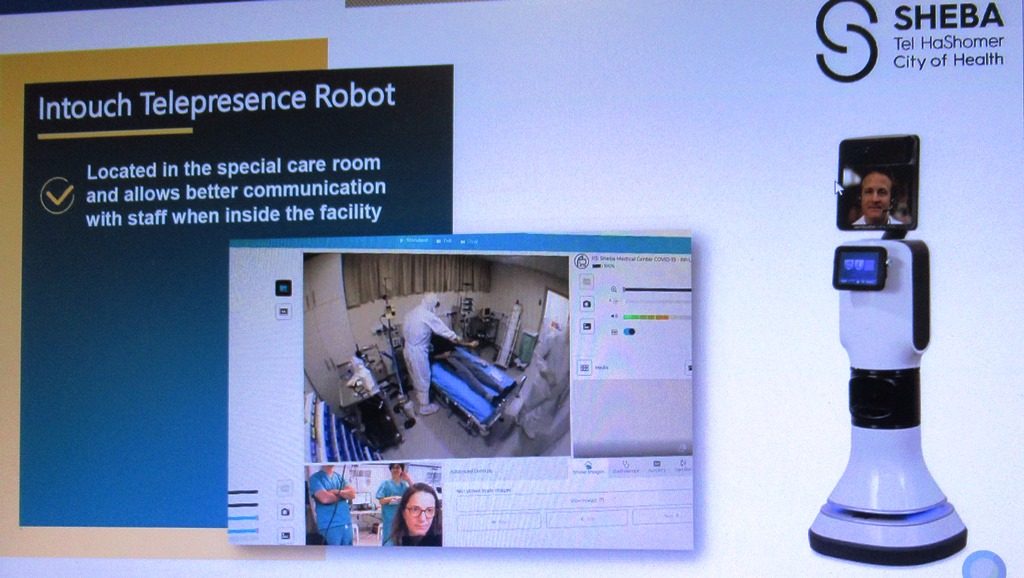
In the hospital, a robot allows less physical contact and closer observation of the patients.
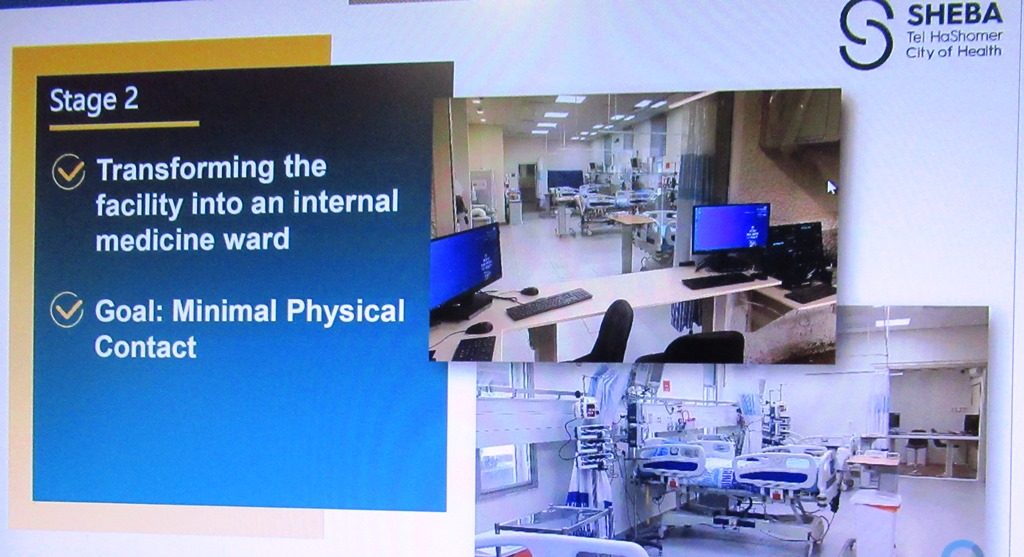
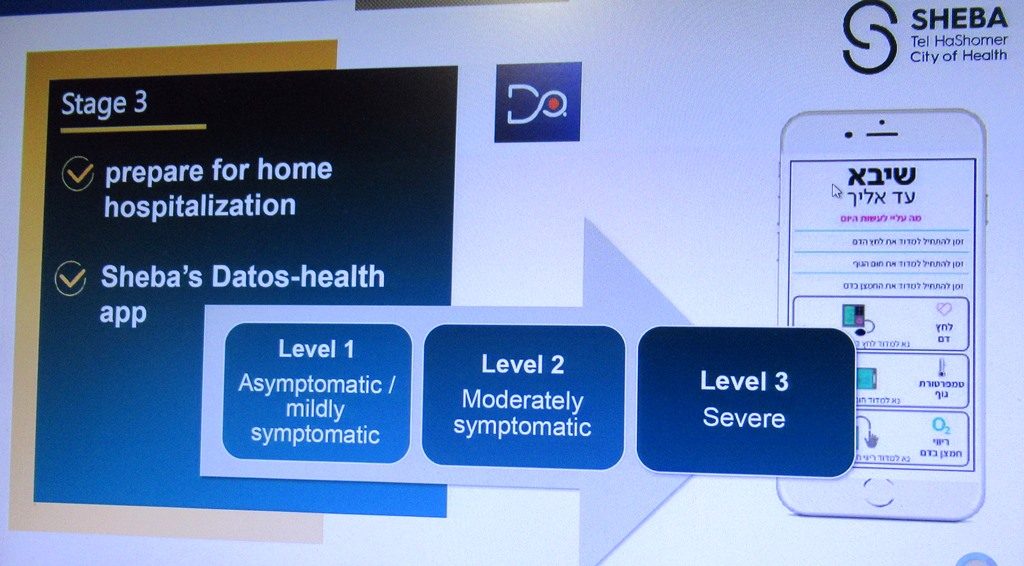
Sheba is on to Stage 2 in the fight against the coronavirus. They have transformed an internal medicine ward into a CCCU. The goal is to protect staff from the virus and provide close observation of their patients. A glass wall was installed, as Dr. Barkai said, like an “aquarium.”
Planned Stage 3 for COVID-19, is to have only the sickest patients hospitalized and less severe cases monitored at home.
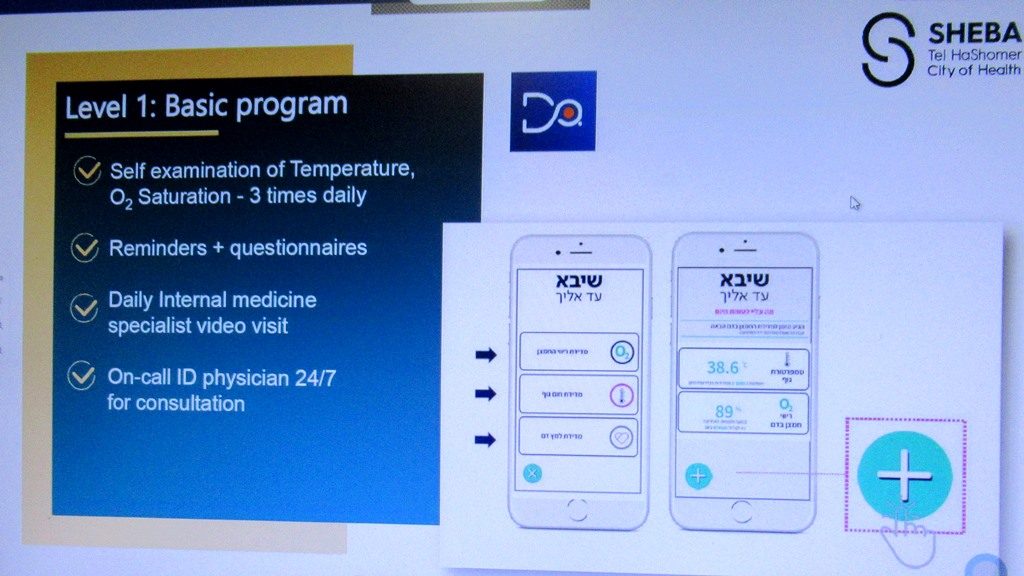
Telemedicine requires self-examination of temperature and Oxygen level, 3 times a day.
A daily video visit is by an Internal medicine specialist, with a doctor on call 24/7 to answer questions.
Level 2, has twice a day video visit, and remote physical exam by Tyto.
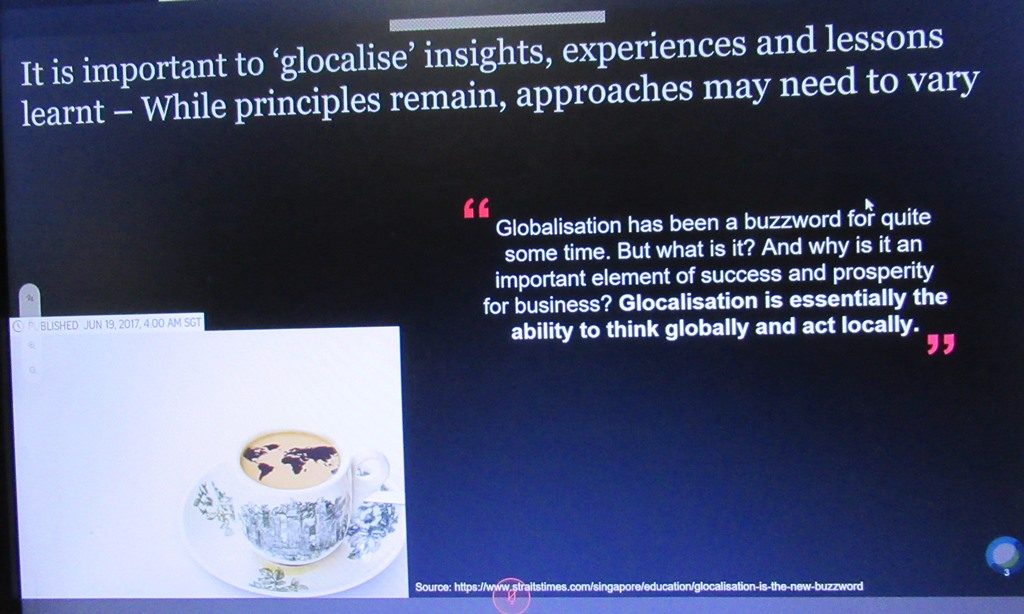
Sharing information, said Dr. Zubin Daruwalla from Singapore, is important to share insights, experiences, and lessons learned. Globalization has been a buzzword for some time.
But Glocalisation is essentially the ability to think globally and act locally.” Principles remain, but approaches may need to vary in different cultures.”
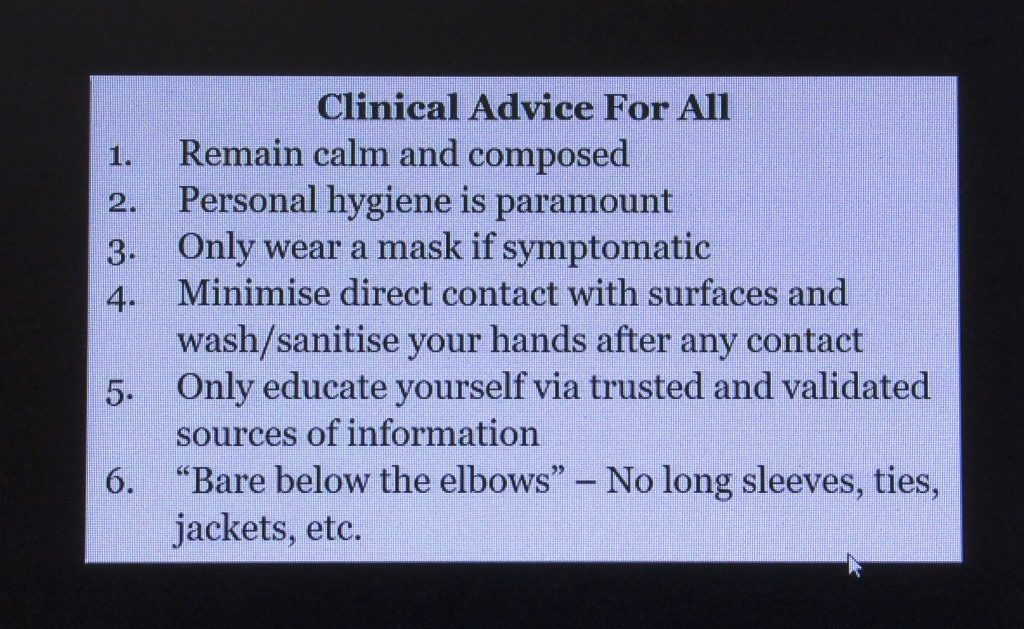
The best summary of COVID-19 expert advice these 6 simple steps.
On Thursday night, March 19, 2020, Israelis came out of their homes for 2 minutes to applaud, to show their appreciation for medical personnel. Hard at work, putting themselves at risk, to treat those affected by the novel coronavirus COVID-19, and say a collective “Thank You!”