Jerusalem a Week of Color, Culture, and Contrasts

Another week in Jerusalem, Israel filled with contrasts.

This photo essay will focus on culture and color in Jerusalem, not crises.

The white autumn clouds drift in the blue skies over the Jerusalem streets.

Construction continues blocking the streets as buildings rise higher and higher.

A special movie screening was held at Jerusalem Cinema City on Monday night.

Tragic Awakening premiered in Israel with a private screening. Rabbi Raphel Shore, the director, was in the US promoting the film and his new book. However, others involved with the documentary exploring antisemitism were on hand to participate and share their ideas.

Rabbi Shalom Schwartz, one of the producers, and Rawan Osman, the star, spoke with Fleur Hassan Nahoum after the screening. Rawan’s journey from antisemite to finding Judaism is a fascinating story.

Tourism is down. This large souvenir store inside Jaffa Gate has closed.

But Mamilla Mall is often as busy as ever with no vacant stores.

The Tower of David’s new cafeteria was open and busy. But a tour of the newest exhibit was the reason to come back again to see what was new in the Tower of David Museum. Please notice the new trees.

A tour of “On the Other Side” led by Zadok Ben-David was a highlight of the week.

His two-minute video in the temporary gallery features bright flowers.

This Is – Same Place Other Times was created in January 2023.

It goes to blackened fields, but circles back around to the new growth. Almost prophetic?

In the same darkened gallery, is this astounding work, where he explores acute transitions in the natural world with butterflies. Did you notice the human form as the center of each colorful creature?

On the reverse side of this large circular piece under blue UV light – roaches. Zadok discussed the beauty of the butterfly in contrast to the creepy caterpillar.

Exploring transitions in the natural world, there is a site-specific piece of a male form in 15 poses outside.

The exhibit ends bright, colorful, and hopeful with three flowers at the new exit onto the street inside Jaffa Gate (where the old entrance was located).

When I first arrived at the Tower of David entrance, with the sun shining. I thought these figures were newly planted cypress trees. How wrong I was!

With Zadok Ben-David’s work, you have to take time and look at the details. Those were not leaves. They were human shapes. Each of the seven trees shows growth from the first sparse tree to a full one at the other end.

The exhibit goes until April.

Design Week also opened at Hansen House this year titled “The Ark.”

Hundreds of visitors filled the spaces outside for the opening event where the Mayor came to speak.

The inner courtyard had pieces of art and displays filled the buildings and campus.

In one room Bezalel students made colorful videos.

Fascinating fashions filled another room.

Entering “The Factory” felt like a scene from Willy Wonka. So much fun, I should go back. Design Week runs until September 26, 2024. Something for everyone, so much to see, this is barely a taste.

Hmm, these guys were arriving at Hansen House as we were leaving.

So fascinating is Rawan Osman, for the second time this week, I went to hear her speaking with Paul Gross at the Menachem Begin Heritage Center.

This is one protest site across from Cinema City.

And yellow ribbons are found on many of the Jerusalem streets.

And also the sounds of music. A new musical preview of David, the Servant King, premiered.

Talented women performed the new songs written by Shlomit Koffler Weinreb,

to a full house, all-women audience to start the week on Sunday night.

War rages on north and south, and no one forgets the hostages, or soldiers, or those in danger, or those forced out of their homes for almost a year.

But, on Thursday night to end the week, a Wine Festival attracted hundreds to First Station.

L’Chaim, to life, to life l’chaim.

Jerusalem Remembering September 11 and October 7 – Planning for the Future

Does anyone over kindergarten age on September 11, 2001, not remember where they were?

I was taking a walk in the Washington, DC, area that morning.

The sky was so blue.

The weather was unusually perfect.

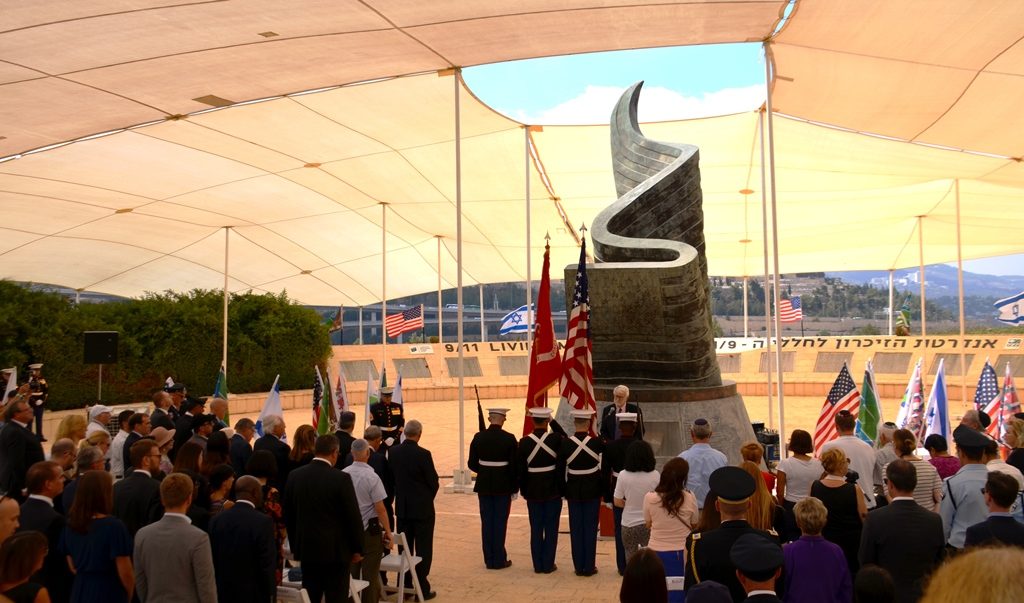
Each year since 2009, a commemoration is held in Jerusalem, Israel, to remember those murdered on 9/11. It is the only memorial outside the US with the names of all those who lost their lives to terror.

In the monument, there is a piece from the Twin Towers that were destroyed that horrible morning.

The commemoration is sponsored by the Keren Kayemeth LeIsrael-Jewish National Fund (KKL-JNF), Jewish National Fund-USA (JNF-USA), and the Embassy of the United States of America in Israel. It is held at the site of the 30-foot-high bronze sculpture created by Israeli artist Eliezer Weishoff.

This year it was held on the evening of September 11, 2024.

JNF-KKL memorial outside Jerusalem Israel for victims of 9/11

The flame design of the US flag looked different than in past years (see Remembering September 11, 2018) when the program began at midday with a tent-like covering to protect participants from the sun.

This year had yellow ribbons and references to October 7 and the continuing war and hostages in Gaza.

International fire fighters, police and military came in uniform.

The ceremony began with standing the presentation of flags by the Marine honor guard and the singing of the Star-Spangled Banner.

US Ambassador Jack Lew spoke with David Borowich Yaari and Hillel Fuld before the program began.

Hillel Fuld took a selfie with an IDF lone soldier whose father was killed on 9/11 before she was born.

Her father’s name is one of the almost 3,000 listed along the memorial wall.

Each year the program ends with memorial wreaths placed by honored guests.

To begin the week, the Israel Defence and Security Forum (IDSF) and the Danube Institute of Budapest sponsored a conference, “The October Effect- Strategic Implications for Israel and Europe in the Middle East War” at the Menachem Begin Heritage Center in Jerusalem, Israel.

The morning panel moderated by Jamie Geller discussed the tidal wave of antisemitism engulfing the West. Fleur Hassan Nahoum, Israel Special Envoy for Trade and Innovation, Laszlo Bernat Vespremy, Historian Jeff Ballabon, Senior Counsel for International and Government Affairs at the American Center for Law and Justice (ACLJ), and MP Michael Freilich, Belgium Chamber of Representatives participated.

“We knew we had problems since Durban in 2001” when the delegitimization of Israel began, was the opening of the remarks of Brig. General (Res) Yossi Kuperwasser the Director of Research at IDSF.

It was a long day with information and international speakers.

The closing panel discussed the Russia-China-Iran Axis and the US. Kristof Verese, International Director of the Danube Institute moderated a fascinating but not encouraging discussion with Or Yissachar, Vice-President IDSF, Monika Palotai, Religious Freedom Institute, and Robert C, Castel, Hungarian Israeli Security Policy expert.  The lack of leadership from the US has led to a shift in world alliances.

However, the last two speakers offered some optimism to close out the day.

Janos Lastofka, Head of the Department for Middle East and North Africa and former Deputy Head of Mission of the Embassy of Hungary spoke of Hungarian citizen support as Israel was attacked brutally.

Also, MEP Tomas Zdechovsky, a Czech politician with 5 years in the EU Parliament, stated that his country was pro-Israel.  His warning was to beware of cyber attacks from Iran. 

For those who want more, here is a site to check.

Not to be forgotten -A War on Two Fronts? The Hezbollah Menace.  Lieutenant Colonel (Res) Sarit Zehavi, Chair of the ALMA Center for Research in the north contributed. She is the expert who lives in the north.

The Michael Levin Base held its annual gala fund raiser at the Kahn Theater to a sold-out crowd.

It’s a Jewish function, so there was food after speeches and awards in support of lone soldiers.

Around Israel, as at Ohel Nechama Synagogue in Jerusalem, fairs have been set up to support businesses adversely affected by the October 7 War.

But, also in Jerusalem, while remembering the war and hostages –

New signs for the 2024 Israel Festival and Design Week are posted along Jerusalem streets.

A new program for young adults “Keeping on Track” has the first session focused on gleaning insight and learning from our past on September 18. The second session looks forward, to “helping you plan your future with tools that are both tangible and meaningful” the next night at “HaMiffal” Center.

The workshop, which will be in English, is intended for young adults aged 18-40.

Road work on Jerusalem streets continues in many locations with more foreign workers arriving.

New buildings are rising as this one on the Givat Ram Campus.

The Jerusalem Roof Top Festival is expanding to many new locations, too many to include now.

Meanwhile, sadly the military cemeteries are expanding in too many locations.

The IDF has many units and branches. One special program supports soldiers with diverse issues. At the 9/11 commemoration, a special choir performed “Wind Beneath my Wings.”

The lighting on the monument as the program came to a close.

May good and light overcome the darkness for a brighter future for all.

In Jerusalem Preserving and Presenting the Past in New Ways

In a week when war raged all around, there were still good things happening in Jerusalem, Israel.

We can not predict the future, but in Jerusalem, the past is being preserved and presented in new ways.

Our week began on the Tayelet, with the Old City in view, for a special morning prayer service. Preserving the past through prayer and continuing our tradition with a boy putting on tefillin for the first time a month before his bar mitzvah.

At Yad Vashem, the David and Fela Shapell Family Collection Center opened.

Entering the lobby of the new building, one sees a video art wall created by video artist Ran Slavin, entitled “122,499 Files.” It is a unique installation, showcasing over 100,000 artifacts, artworks, photographs, and documents from Yad Vashem’s collections, many of which are too delicate and fragile to be displayed. The innovative work includes many items being viewed for the first time, explained Simmy Allen, head of International Media Affairs and Communications, who led the tour.

The building is five stories, with four of them underground.

Outside near the entrance, you can look down and marvel at the details that went into the planning.

The advanced laboratories handle all aspects of preservation, from registration to storage to conservation; both for the museum’s use and archival purposes, ensuring that each item is treated with the utmost care and made accessible for future generations.

From textiles and preserving a prison uniform

or a woman’s cherished childhood teddy bear.

There are not many oil paintings of museum quality, as during the Holocaust people used whatever they could find to write or draw on. This large painting from Krakov in 1929 was on a table. Looking at the signature, I was surprised to see my grandfather’s family name before he changed it in the US.

Every item is treated with dignity. Some of the horrors are too difficult to view.

Yad Vashem holds approximately 227.6 million pages of documentation, 2.8 million Pages of Testimony, 541,500 Holocaust-era photographs, 31,000 artifacts, and 14,000 works of art. 

One emerges from the depths of the archives into the daylight and the newly landscaped campus.

Also opening this week was the new contemporary art exhibit at the Kishle in the Tower of David called “Umbilicus,” by curators Dr. Adina Kamien and Malu Zayon. Kishle means prison in Turkish.

The Tower of David Jerusalem Museum has been undergoing extensive renovations to make the ancient fortress accessible.

This was the entrance to the Kishle ten years ago when the public could first see the vast space near Jaffa Gate, following the extensive archaeological excavation in 1999-2000 led by Dr. Amit Re’em. 

Work on a new entrance ramp to replace the rickety metal spiral staircase was visible in 2023.

Today it is an easier climb, but there are plans to make it more accessible in the future.

In my November 2014 visit to the Kishle, the graffiti of the Irgun prisoners was visible on the exposed wall. Built by the Ottoman Turks as a jail in the 1800s, it was used by the British in the 1940s to hold captured Jewish militia members.

Today the archeological markings of excavation are visible, but also pieces of contemporary art. The Red Dream (Window) by Lihi Turgeman is displayed on that wall.

The new steps are more stable and an easier climb, and worth the effort to see 2,800 years of history presented in a new way with contemporary art.

Also this week, the National Campus for the Archaeology of Israel opened its doors for Hebrew tours.

Located next to the Bible Lands Museum Jerusalem and across from the Israel Museum, the grand opening was held in October 2016.

The carefully restored artifacts were shown briefly at the time.

There were centuries of glass pieces arranged in display cases.

Construction was well underway.

Landscaping had begun. Then its doors were closed and locked for years.

The proposed library was a mere shell on my first visit in 2016.

The Jay and Jeanie Schottenstein National Campus for Archaeology of Israel library

How good to see the dream of an extensive collection of all archeological works become a reality in 2023.

The trees have grown and the interior spaces are now in use. Now I’d like to see the deep underground lower levels where the most valuable pieces are safely preserved.

At Safra Square, very different memories are preserved and shared.

Veteran Jerusalemites are featured on large posters on each side of the government plaza this summer. This couple born in Ethiopia says “To arrive in Jerusalem was the fulfillment of a dream.” There are other posters with similar positive statements.

Also this summer, there is ice skating to keep cool at First Station, and music in the garden of the National Library of Israel.

The food trucks are back this year at the Tayelet, on Tuesday – Thursday evenings.

The decades-old International Arts and Music Festival will return to the Sultan’s Pool, where summer concerts have begun at night and the Jerusalem Film Festival will open this week.

So, with our thoughts and prayers for the safety of hostages and IDF soldiers, we can drink l’chaim.

Jerusalem, Israel, has much happening to preserve the good times along with its history.